By Philippe Picardat
Social class within America is an increasingly growing issue socially. It can be observed widely when looking at races, and indeed how the echoes of racial segregation still haunt todays America. Social class as defined by Blacks Law Dictionary is “A hierarchy of status where people are classified according to wealth and prestige. It refers to any level present.”. Looking through this lens of social class, we can observe how to potentially remedy the issues and the gap, of social class by means of mass communication.

A depiction of the modern triangle of the modern American social classes.
The roots of this issue are as old as Jim Crow laws, starting towards the end of the 19th century, and clearly still existing up to today. George Takaki even alludes reference to this, multiple times it should be noted, in his book A Different Mirror, “By the end of the nineteenth century, however, the possibility of progress for blacks was distressingly remote. Racial borders had been reinforced by class and caste. Most black farmers were sharecroppers or tenants, working a white man’s land with a white man’s plow and a white man’s mule.” (pg 130). This can only be further reinforced from an article from Forbes Magazine, titled The Racial Wealth Gap: Addressing America’s Most Pressing explains; “The term “systemic racism” ruffles a lot of feathers. It often triggers emotional arguments about how people feel about racism and its effects. Yet concrete data over long periods of time shows very clearly that systemic racism exists. Blacks were historically prevented from building wealth by slavery and Jim Crow Laws (laws that enforced segregation in the south until the Civil Rights act of 1964). Government policies including The Homestead Act, The Chinese Exclusion Act and even the Social Security Act, were often designed to exclude people of color. For example, in the 1930s, as part of the New Deal, the Federal Housing Administration (FHA) created loan programs to help make home ownership accessible to more Americans. The Government created color-coded maps — green for good neighborhoods and red for bad neighborhoods — to determine who got those loans. Spoiler alert: many neighborhoods were designated as red because blacks and other people of color lived in them. This process, known as redlining, systematically prevented them from not only getting home loans but also encouraged developers in green areas to explicitly discriminate against non-whites. This often led households of color into wealth stripping “land contracts,” where they paid exorbitant prices for homes that they could lose very easily. Epidemic Indeed, many defining aspects of social class are imbued within the concepts of race in fact, it has had such an impact the aspects that come with social class are reflected in popular music, particularly from the African American community. An understandable side effect to be attributed to the systematic racial segregation.” (Forbes Magazine, Course Reading).

Rapper and hip-hop artist Kendrick Lamar has orated wonderfully (and shown in music videos) the class divide between colored minorities and whites. The song Alright is one that displays enormous class divide, at least in its associated lyrics and music video. Kendrick Lamar has often been critically lauded for his lyrics and has even been awarded by multiple music boards for his artistic abilities and songwriting.
https://genius.com/Kendrick-lamar-alright-lyrics
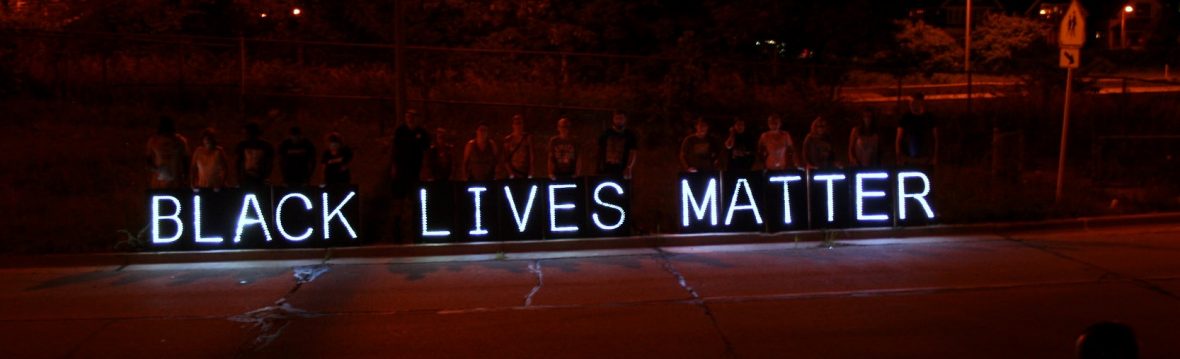
When interviewing Ebony Miranda, an activist from Black Lives Matter, I asked her a few questions on how any help could be provided on negating the more negative messages some artists portray in their music. Granted, these questions were asked on the basis that most popular music today usually discusses the vast acquisition of wealth, and usually squandering it on drugs, or other materialistic indulgences of capitalism, as is a popular subject.
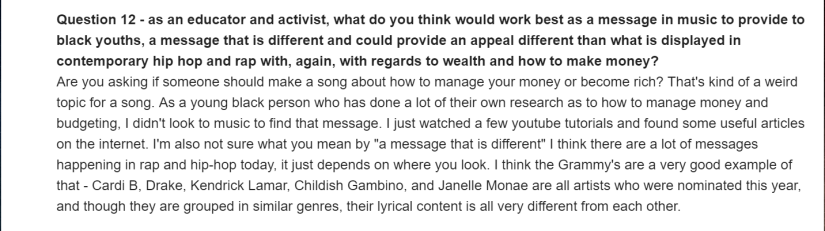
Not all is perilous, however, as there have been steps made towards fixing this issue. Huge steps have been made towards the education towards identifying the causes and pointing out how we all can take steps to take action, inevitably to ameliorate the scars caused by racism. Ebony, again from BLM, stated our best ways to help are to give donations supporting their cause.
Indeed, Neil Postman, author of Amusing Ourselves to Death also espouses ways we can aid in the amelioration of this leftover racism, at least by means of how we choose to communicate today. “And yet there is a reason to suppose that the situation is not hopeless. Educators are not unaware of the effects of television on their students. Stimulated by the arrival of the computer, they discuss it in a great deal – which is to say, they have become somewhat ‘media conscious’. It is true enough that much of their consciousness centers on the question, how can we use television (or computer, or word processor) to control education?” (pg. 162). This begs the question, how can we, as our generation is, can use our technology in ways that are actually productive. Of course, caution must be taken in order to avoid the tribalism social media has bred to the degree it exists today.
This blog post contains possible copyright material that is used for educational purposes regarding the portrayal of social class in American music. We are able to use this material on this website because of the Digital Millenia Act of 1998 that added on new regulations regarding digital copyright laws. However, this blog post is compliant with the copyright laws due to the fact that the material used gives proper credit to the original authors and the information used is for educational purposes only.
Sources:
Postman, N. (2006). Amusing Ourselves to Death: Public Discourse in the Age of Show Business (20th-anniversary ed.). New York, N.Y., U.S.A.: Penguin Books.
Takaki, R. (2008). A Different Mirror, A History of Multicultural America. New York, NY: Back Bay Books.
The Racial Wealth Gap: Addressing America’s Most Pressing Epidemic (Classroom Reading Material) https://www.forbes.com/sites/brianthompson1/2018/02/18/the-racial-wealth-gap-addressing-americas-most-pressing-epidemic/#c3774657a48a
Alright; Kendrick Lamar
Lyrics
https://genius.com/Kendrick-lamar-alright-lyrics
Blacks Law Dictionary – Social Class
https://thelawdictionary.org/social-class/
Social Class pyramid graphic
Kendrick Lamar image
 AMERICAN MUSIC